I Led a Zephyr Race and Immediately Became a Liability
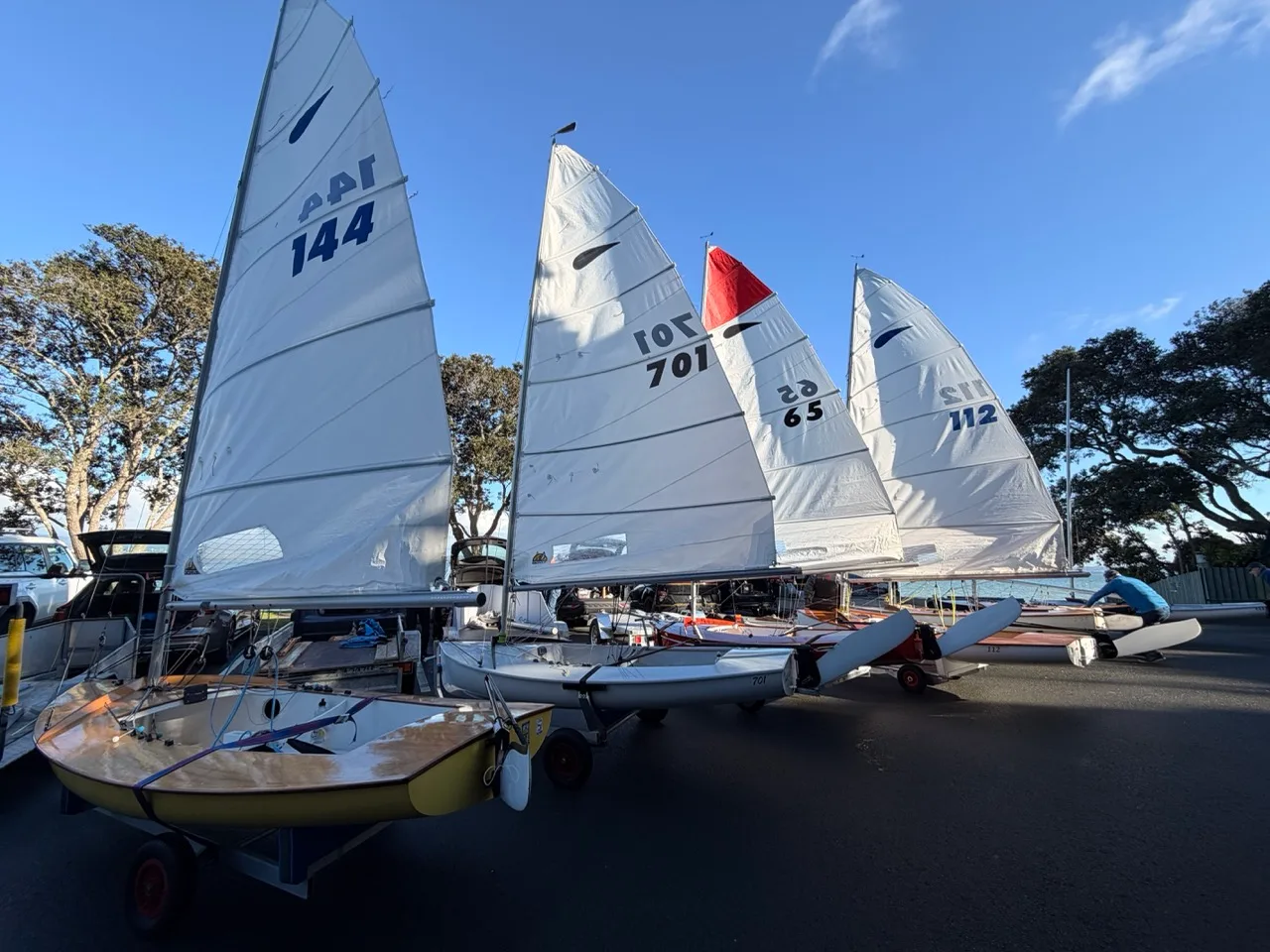
My unhinged Zephyr Sailing Report – Sunday, 16 August
Well, things are finally starting to come together for Julie and me.
We made a promise to each other – or, more accurately, I spoke and she listened, that our next outing would be different.
And it was.
Things took a turn, finally in the right direction.
After three consecutive race days spent sulking in the boat park, cranky with each other and struggling to understand what we really needed from the relationship, Julie and I finally made some progress.
Until now, communication had been difficult. I’d ask her to point higher; she’d refuse. I’d try to get her moving; she’d sit there like a stubborn old bath. I’d pull one string, ease another and offer increasingly desperate encouragement, but she remained heavy, unresponsive and apparently determined to embarrass me in front of all her friends.
I was beginning to wonder whether the problem was me.
It was, obviously. But it wasn’t entirely me.
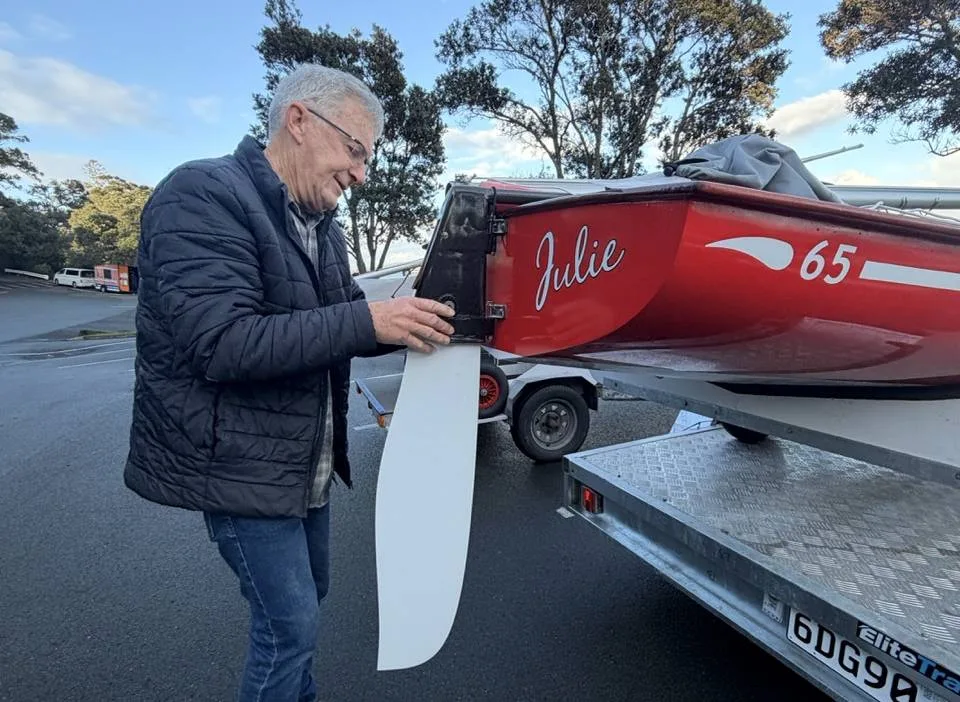
A new centreboard and rudder have certainly helped. Together, they’ve practically halved the weight we’d been dragging around, a useful reminder that sometimes the best way to revive a troubled relationship is to replace a couple of ageing appendages with something lighter, stiffer and considerably more expensive.
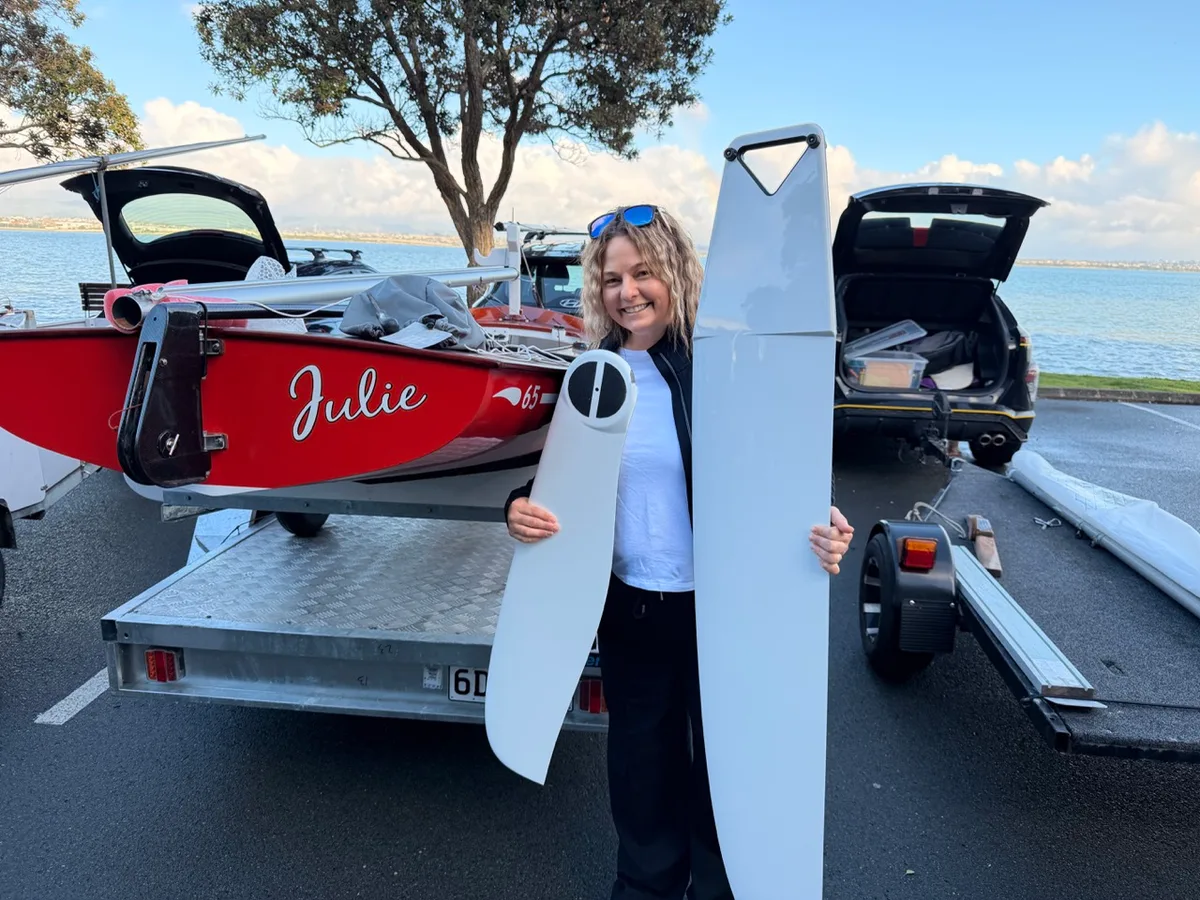
A few strategic tweaks around the base of the mast have also improved our performance. I won’t go into too much detail (cause I still don’t really understand what was changed), but once everything was sitting in the right place, properly supported and under the correct amount of tension, Julie became a completely different woman. Thank you Brian Peet for the educated adjustments, and to Carla Bennett for the tape measure!
The conditions played their part too. Instead of another tedious drift-off, with the two of us fidgeting like meerkats and avoiding eye contact, there was actual breeze.
At last, we got to use those vintage hiking straps. We leaned into the relationship, and mostly out of it, with my butt over the side, legs stretched and muscles trembling from the unfamiliar effort.
It wasn’t elegant, and I’m not entirely sure either of us knew exactly what we were doing, but for the first time in weeks there was energy between us.
We were alive, and we were moving. We may even have been enjoying ourselves.
Going into the day, I’d also made a significant attitude adjustment. I had two choices: I could continue stomping around the boat park like a petulant child whose ice cream had fallen off its cone, or I could pull my finger out and face what was actually in front of me.
Just a reminder – the racing is hard and the conditions at Point Chev are always challenging and I’m racing against and a fleet containing sailors who seem to have been in the class since shortly after the invention of wind.
These people know things. They can smell a wind shift before it arrives. They can detect half a knot of tide by dipping a finger into the water and narrowing their eyes. They adjust six different controls without visibly moving, then casually explain afterwards that they won because they eased the thing-ummy rope half an inch when a slightly darker patch of water appeared somewhere near Te Atatu.
Meanwhile, I’m still trying to remember which coloured rope does what.
I’ve also learned that my mental health is directly proportional to how high I point.
A few good upwind legs and I’m emotionally buoyant for days. I’m patient, productive and unusually pleasant to be around. Messages get answered, deadlines feel manageable, and even the painfully slow elevator to my apartment building feels less like a mechanical failure and more like an opportunity to quietly relive my best tack.
But spend an afternoon being sailed over and tacked on and my entire psychological framework collapses. That same elevator becomes a vertical prison, moving with all the pace of a Zephyr in no breeze while I stand there replaying every bad decision from the race, and several unrelated ones from my rebellious teenage years.
That’s sailing. We pretend it’s a relaxing weekend hobby, then allow five degrees of pointing ability to determine our emotional stability for the rest of the week.
We’re all in the same boat. Unfortunately, some of you bastards are several boat lengths to windward.
I was, and still am, the new kid in the boat park, and on the racecourse. Everyone else seems to know where the breeze is going, where the tide is flowing and which end of the start line will pay. I’m usually pleased if I know where the start line is.
Eventually, after an agonising general recall, the first race got underway.
The recall had given us another opportunity to practise barging, shouting and pretending we knew precisely how many seconds remained. Then the fleet regrouped, the sequence began again, and we charged toward the line like a herd of mildly confused aquatic livestock.
The gun went and Julie and I came off the line with pace.
We were in clear air. The boat felt light and the groove was there. Julie lifted her skirts, dug in her new appendages and took off as if she’d suddenly remembered she had a reputation to uphold.
Then I looked around. There were boats behind us. Not one boat. Not two boats. The whole bloody lot of them!
Julie and I were at the front of the entire damn fleet!!!
We had clear air and the entire Zephyr fleet behind us, presumably staring at our transom and wondering whether an administrative error had been made. For one glorious moment, Julie and I had everything we’d ever wanted: speed, height, space, power and a long line of experienced sailors forced to look at her beautiful red transom.
It was magnificent and intoxicating. It was also completely terrifying.
After weeks of blaming the boat, the weather, the tide, the equipment, the phases of the moon and each other, Julie and I had finally reached the front.
Which raised a deeply troubling question: What the hell were we supposed to do now?
We rounded the top mark still in the lead, and our glorious reign continued for approximately another three minutes.
While Julie had spent the upwind leg pointing toward the moon and making me look far more competent than I really am, it quickly became apparent that our downwind coordination still needed a little work.
Upwind, we had chemistry. Downwind, we needed counselling.
By the first wing mark, our lead had evaporated and we’d slipped back into third. Still respectable, of course, but once you’ve briefly tasted life at the front, third feels less like a podium position and more like the opening stages of a highly public collapse. At this point, I remembered the advice my friend Cam Thorpe had given me before we headed out:
“Don’t worry about the results, they aren’t important. Just get Julie moving and stop overthinking things. Once you learn to calm down, everything will fall into place. I’ll say it again: don’t focus on the results.”
Yes, Cam. Okay, Cam. Excellent advice, Cam.
But can I focus on the result if I’m leading?
Surely “don’t worry about results” is advice for people safely buried in the middle of the fleet, not people who have unexpectedly found themselves at the pointy end and are desperately trying to stop everyone discovering it was an accident.
It appears I should have listened to him, because while I was busy defending my position, calculating where the boats behind me were going and attempting to look like a sailor accustomed to leading Zephyr races, I began doing dumb shit.
Most notably, I dropped the tiller extension. Three times. In one race…
Once is unfortunate. Twice suggests a developing problem. Three times is the sailing equivalent of repeatedly dropping your fork during dinner with the King and then insisting you’re completely relaxed.
Each time, Julie wandered off on her own while I scrambled around the cockpit trying to recover the little black stick that was supposed to connect us, along with my control, composure and rapidly disintegrating dignity.
Those clumsy mistakes cost us dearly, and our brief appearance at the front became another “valuable learning experience,” which is what sailors call it when they cock something up and don’t want to discuss the result.
So, Cam, you’ll be pleased to hear that I have absolutely no idea where I finished.
Technically, I wasn’t focused on the result, I was focused on being in the lead… And then losing it.
The next two races were, well… interesting.
As the breeze shifted, the top mark was moved to keep the course vaguely respectable. The pin end of the start line, however, stayed exactly where it was, anchored in position and refusing to acknowledge that anything around it had changed.
The result was less of a traditional upwind start and more like reaching for a hot mince and cheese pie, only to have it land upside down in your lap and explode.
There was shouting. There was pastry everywhere.
Because Julie is only on loan to me, I was understandably nervous about throwing her into the middle of the chaos. She’s far too pretty for a boxing ring, and I didn’t fancy explaining to her owner why she’d come home covered in bruises, scratches and fragments of somebody else’s Zephyr.
So I made the cautious, and thoroughly unheroic, decision to stay out of trouble and start from the back row. This protected Julie’s complexion, but it came with its own set of problems: dirty air, limited options and an uninterrupted view of everybody else sailing away from us.
Normally, this would have been the perfect opportunity to drop my bottom lip and begin preparing a detailed, heavily footnoted list of external factors responsible for my position, but I’d chosen to start at the back. I couldn’t sulk about a situation I had deliberately created.
Well, I could… But even I would have struggled to make it convincing.
Instead, I turned it into a challenge. Starting from the back gave me the chance to see how far through the fleet Julie and I could climb, and how many boats we could hunt down upwind with our newfound height and speed.
It worked, to some degree.
In the final race of the day, we managed to overtake five boats on the second upwind leg. Julie was pointing beautifully, driving through the chop and steadily reeling them in one by one. It turns out starting at the back has one major advantage: there is no shortage of people to pass. It also kept us far enough away from the pointy end that I didn’t have to “worry about the results,” so Cam would have been proud.
By the end of the day, I had absolutely no idea where I’d finished overall. But for once, that genuinely didn’t seem important.
What I did know was that Julie felt lighter, faster and more responsive. We had led a race, we had passed boats, we had survived two exploding-pie starts without damaging her lovely complexion. And, most importantly, we had finally started working together instead of blaming each other for everything that went wrong.
Regardless of what the results sheet eventually says, it was easily the best day of racing I’ve had since launching Julie a few months ago. It wasn’t perfect, but neither of us sulked in the boat park afterwards. And for this relationship, that might be the biggest victory of all.
There’s no racing this weekend. In fact, we won’t be back on the racecourse until 6 September, but that doesn’t mean Julie and I will be sitting around staring silently at each other. Between now and then, there will be some on-water training, a few onshore tweaking sessions and probably another heartfelt, one-sided conversation about where this relationship is heading.
The aim is to keep our newfound progress on track, and perhaps learn how to sail downwind without requiring professional mediation.
So, if you’re in Auckland and see a red Zephyr launching from Eastern Beach, come and say hello. If I’m pointing toward the moon, everything is going well. If I’m crawling around the cockpit looking for the tiller extension, please avert your eyes and allow me to retain what little dignity remains.
The fleet is growing too.
People are taking an interest in the class. Boats are being bought and delivered to excited new owners, while second, third and even sixth-hand Zephyrs are finding new homes with eager sailors ready to embrace the “new” wooden boat in their lives. And that is part of what makes this class so special. A Zephyr doesn’t become old, it simply accumulates stories, owners and increasingly creative repairs.
This class is fantastic.
The banter, both on and off the water, is one of the main reasons I keep coming back. The friendships being forged are the kind that will stand the test of time, just like the Zephyr class itself.
If Des Townson were still around, I’d buy the man a drink. I’d raise my glass and thank him for creating one of the finest single-handed classes in the world: beautiful, competitive, enduring and just demanding enough to keep every sailor humble.
A boat created for the hardy, warm-blooded and ever-so-slightly unhinged Kiwis, and wannabe Kiwis like me.
Here’s to Des. Here’s to the Zephyr fleet.
And here’s to Julie and me. We’re lighter, faster, pointing higher and, after weeks of emotional negotiations and rig adjustments, we’re finally heading in the same direction.
Julie is a boat, and she can hardly be blamed for the mistakes made by the idiot who’s supposed to be holding the tiller extension.
See more Live Sail Die in Google: add us as a preferred source
Comments